
The True Story of the Wildcatters Who Transformed Texas
The Lone Star State may have been founded by pioneers, cotton farmers, railroad industrialists, and trailblazing cowboys, but Texas is not Texas without sweet crude. Oil remains among the most important commodities in the state. When the oil markets dip, so does Texas’s economy. When the fields are booming, the empty roads running through the flat West Texas plains become as dangerous as any major city. For better or for worse, oil drives Texas, and it has been that way since abundant supplies were discovered beneath the state’s geological formations.
But how did oil come to dominate Texas, and who were the original wildcatters who discovered it? As with most things, Texas’s oil history is familiar to us in legend but more complicated in fact. The first people to know about and use Texas’s oil were the Native Americans. Long before Exxon was formed, people knew there was something valuable hidden beneath the Texas dirt. The question was how to get it?
‘An Odor of Sulfur‘
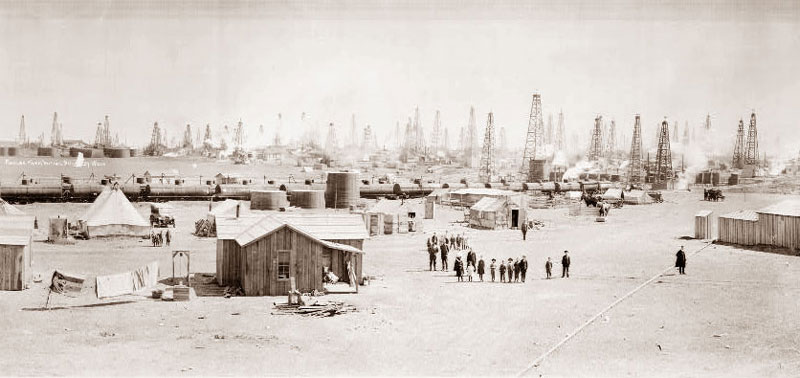
It was Luis de Moscoso Alvarado who made the first report of oil, though he had no idea what he had found. In the 16th century, this member of Hernando De Soto’s infamous expedition to Texas recorded the finding of a strange black substance floating on the water near Sabine Pass. Remarkably, the Spanish explorers immediately recognized a use for the stuff, and they used the crude to caulk their ships.
When Frederick Law Olmsted, a future designer of New York’s Central Park, made his famous trek through Texas in 1854, he noticed a “a slight odor of sulphureted hydrogen” as he passed through Sour Lake.
Texans knew about oil before they knew what to do with it. After the Civil War, Lyne T. Barret managed to drill one of Texas’s earliest oil wells in Nacogdoches County, but he couldn’t figure out how to make the venture profitable. In 1886, a rancher in Bexar County named George Dullnig discovered oil while trying to dig for water, but he also couldn’t make his accidental discovery make economic sense. The first viable oil well was discovered in 1894 near Corsicana and constructed a year later, which led to the opening of the state’s first oil refinery.
The real boom, however, would take place a few years later at a site closer to where Alvarado first spotted oil.
The Gusher
There was no problem finding oil in Texas. The real challenge was extracting it profitably. The necessary technology wasn’t developed until the early 20th century. In 1892, a number of prospectors drilled holes near Beaumont, hoping to tap into what was surely a supersized well. It wasn’t until Anthony Lucas — with the Gladys City Oil, Gas, and Manufacturing Company — began utilizing new drilling bits that he finally hit it big.
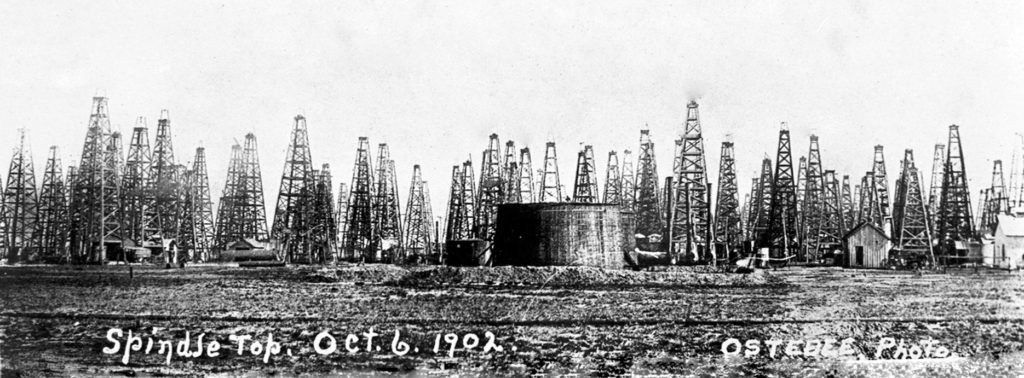
On Jan. 10, 1901, Lucas’s drill struck the oil at the Spindletop field, causing a black eruption of oil to shoot 150 feet into the air. It took nine days to finally cap the gusher. After that, the field began producing 100,000 barrels a day.
The strike at Spindletop could be considered the birthday of the new Texas economy. In 1902, the oil field produced more than 17 million barrels in one year. But its longest-lasting impact was the development of the Texas oil industry. Exploration along the Gulf Coast produced numerous new wells. Companies such as the Texas Oil Company (now Texaco) and J.M. Guffey Petroleum Company (now Gulf Oil Corporation) formed to finance more drilling and to build refineries to process the crude oil and pipelines to ship it. The era of Texas oil had begun, and the image of the oil speculator, who stuck a drill in the ground and struck it rich, captivated the American imagination.
Wildcatters
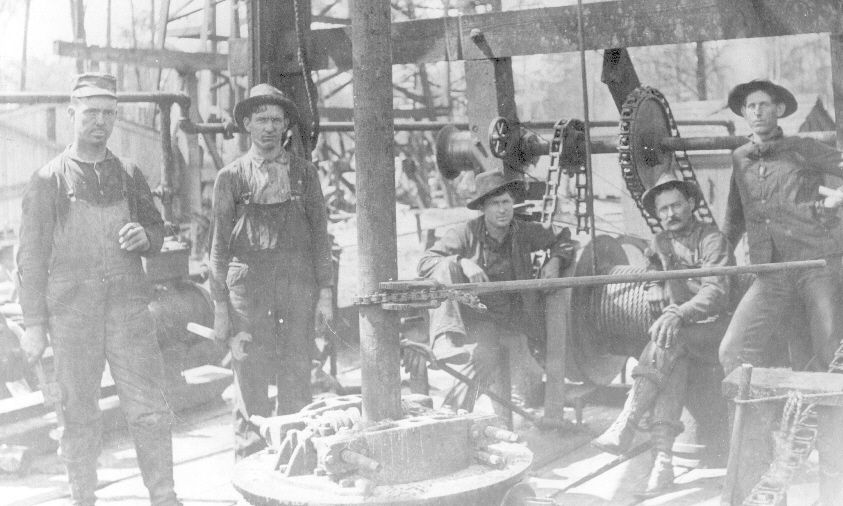
The expansive growth of the oil industry through the first decades of the 20th century didn’t just make many Texans rich; it helped forge a new mythic identity for the state. The term wildcatters came into use to describe the intrepid, hardworking, hard-playing oil explorers who came from little and risked everything to accumulate fortunes.
Glenn McCarthy was one such figure. The Beaumont native’s father worked in the fields, and after injuring his ankle while playing football at Tulane University, McCarthy returned home to start digging holes himself. In the 1930s, in the teeth of the Depression, McCarthy struck oil 38 times. He used his new wealth and larger-than-life personality to live out a flashy public life that inspired the character Jett Rink in the classic novel Giant.
Michael Late Benedum wasn’t born in Texas, and he didn’t discover his first well here. He began drilling in his native West Virginia before going on to discover wells with his partner, Joe Trees, in Arkansas, Louisiana, Illinois, and Colorado. It is said that Benedum drilled more successful wells in more places than anyone else. His biggest find was the massive Yates Oil Field, which opened up the Permian Basin — the field that still drives the Texas oil industry today — for oil drilling.
By the late 1920s, there were productive wells all over Texas and only a few corners of the state where oil hadn’t been found. Columbus Marion Joiner had already made and lost a fortune speculating for oil in Oklahoma when he arrived in Texas in 1926. He and his partner, A.D. Lloyd, began digging holes in an overlooked part of East Texas when, in 1930, they discovered the East Texas Oil Field, the largest petroleum deposit ever found at the time. Joiner, however, soon found himself in financial trouble yet again despite the massive discovery, and he sold his stake in the field to H.L. Hunt.
Texas Crude
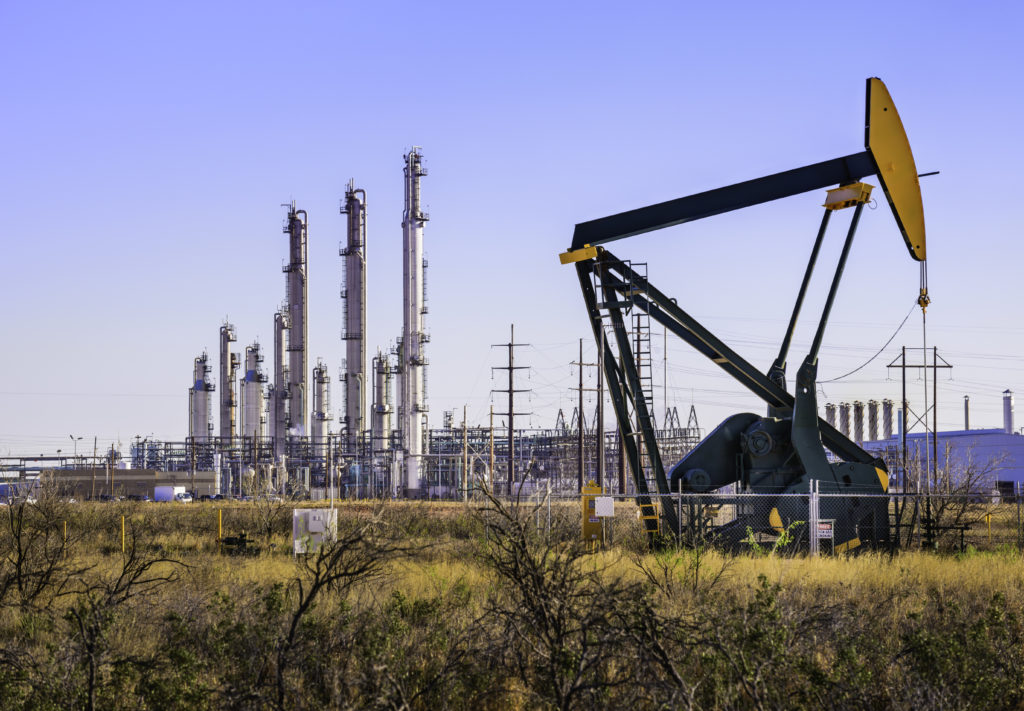
By the end of the 1930s, Texas drove the United States oil economy. With the discoveries came whole new industries to support the production of crude. Refineries were constructed and pipelines laid to create and ship oil products to major markets. Fortunes were made that transformed Texas’s cities and culture. The University of Texas used oil discoveries on its land holdings to create an endowment that has long supported the state universities. The discoveries of the wildcatters and their high-risk, high-reward speculation left an indelible mark on Texas and on the world.
For more Texas history, find out the stories behind the Texas Rangers, our last dance halls, the Texas frontier, or Frito pie.
© 2020 Texas Farm Bureau Insurance