
A Guide to Finding and Growing Cactus
Growing up in California, I was accustomed to cacti. I spent a childhood taking trips to desolate and arresting expanses — to Anza-Borrego Desert State Park, Joshua Tree National Park, and the Mojave Desert’s Death Valley National Park.
We left in the early morning, heading east to see the pink sunrise over the sandblasted rocks, dunes speckled with patches of yucca, and the spindly limbs of Joshua trees. This was the domain of the statuesque saguaro of the Sonoran Desert, the Palm Springs oases that rose out of the arid sand like a mirage, and the fuzzy cholla cacti of Anza-Borrego, where we drove to see the Indian paintbrush and Parish poppies bloom in the two magical weeks after spring rains. I imagined that here were the only cacti in the world.
Then I moved to Texas. I admit I expected that rattlesnakes would be replaced by Longhorn cattle and cacti would be left behind. But in Big Bend, I found a different answer.
One spring morning, on a hike through shifting elevations, I was overcome by the sheer variety of the cacti of the Southwest. More species abound in this swath of land bordered by Mexico and the Gulf than anywhere else in the country. There are more than 100 varieties in Big Bend alone.
Cactaceae, members of the succulent family, are botanical unicorns, uniquely distinguished by their spines and areoles, the cushions from which spiky protrusions grow in clusters that adopt star shapes and other patterns. They store water in their stems to stave off thirst in drought periods. Their gorgeous flowers, crepe-papery or satiny, bloom like teacups drunk from and pollinated by bats, bees, moths, and hummingbirds.
The plant kingdom is diverse, with thousands of species, all perennial and native to the Americas. Like tortoises of the plant world, cacti teach us lessons of endurance; stubborn survivors, they’re made to encounter adversity. And they have their own particular beauty. Just like Texas.
Native Varieties
See if you can spot these on your next trek.
Illustrations by Vincent Lucido
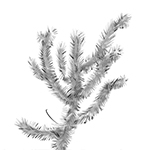
Cholla
(genus cylindropuntia)
This category includes the wonderfully named teddy bear cholla, whose chubby, cylindrical stems bristle with golden spines, and the tree cholla, whose branchlike stems bloom with brilliant violet blossoms and bear orange fruit.
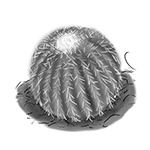
Barrel
(genus echinocactus)
These accordian-ribbed cacti include the horse crippler, with a beautiful, delicate, ruffly pink flower, and the Turk’s head, with reddish spines on a blueish stem.
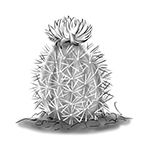
Warnock’s pineapple
(echinomastus warnockii)
Named for Barton Warnock, a botanist at Sul Ross State University, this cactus looks like a pineapple topped with a gorgeous white bloom.
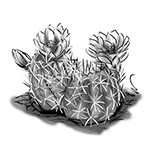
Hedgehog
(genus echinocereus)
Small, ribbed cacti with beautiful, lacy patterns often in bone-white spines, the hedgehog displays stunning magenta flowers.
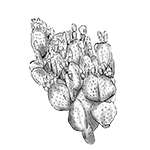
Prickly pear
(genus opuntia)
The purple prickly pear has an attractive purple stem; the genus blooms with lavish fuchsia, yellow, and peach flowers.
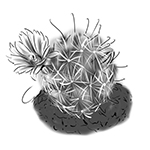
Fishhook
(genus ferocactus)
These barrel-shaped cacti display distinctive curving spines.
Home Growing
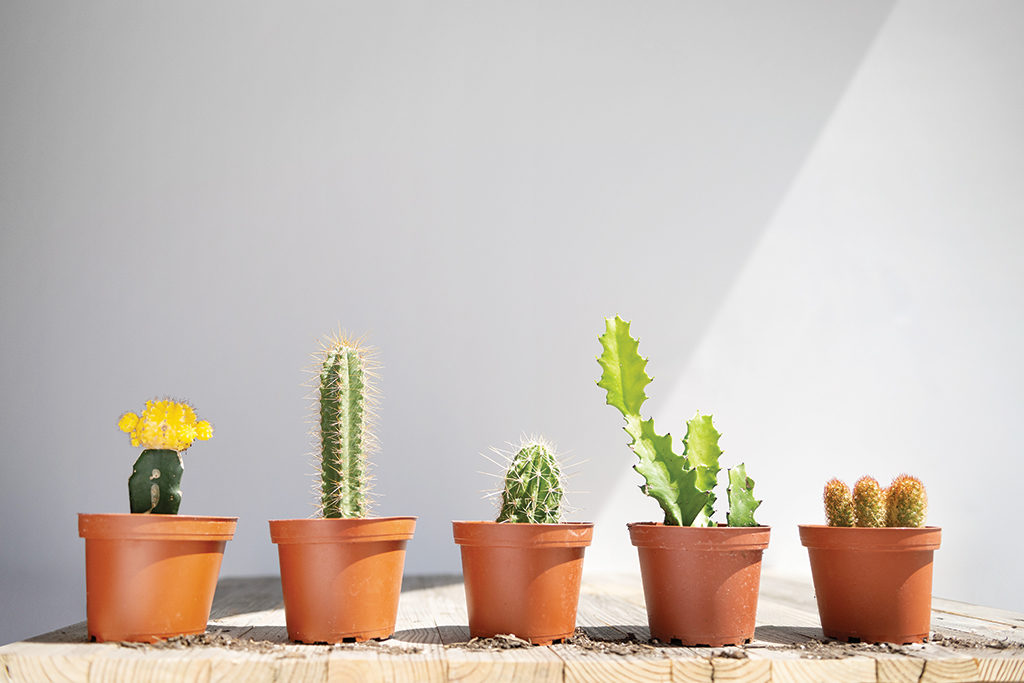
Bring a cactus into your home and care for it, and you capture a little bit of the wild desert vastness in your home or landscape. Cacti demand very little of us. They want a few critical elements — sunlight, a little water, and well-drained soil — and are a boon to the timid gardener. Here’s how to become a cactus parent.
Step 1: Pick up a cactus at your local plant nursery or pluck an offshoot from a healthy, robust cactus. If you choose the latter option, dry it for a few days until the wound forms a callous, then plant your cactus pup callous side down.
Step 2: Cacti want to dwell in a desert, essentially. Build cactus-friendly soil. Mix cactus potting soil with equal parts gravel, lava rock, pumice or pearlite, and sand. This will allow proper drainage to prevent mold and rot.
Step 3: Choose a pot that gives your cactus room to expand. For a tall cactus, choose a pot with a diameter half the mature cactus’s height.
Step 4: Don’t overwater. (And only mist until roots grow.) Plant cacti in dry soil and wait one week before watering; then water only when the top inch or so of soil is dry.
Step 5: Cacti can thrive indoors or out. (If you plant outdoors in pots, you can take cacti indoors in the wet winter months.) Sunlight is a must. Without plenty of sun, cacti develop spindly, uneven growth. But also avoid harsh, continuous exposure: Cacti can get sunburned too.
Find more home gardening hacks here.
© 2019 Texas Farm Bureau Insurance