Please sign in as a member or guest below to access it.
Please sign in as a member or guest below to access it.

Military families and veterans have all sorts of help meeting the everyday challenges they face.

This is the reality for many military families. They do it because they want to. Because they love their country. But all of them need support — from managing finances to handling the emotional toll of military life.
The military offers help, along with countless nonprofit groups and grateful civilians who volunteer time, talent, and money — especially in Texas. It’s a state where thousands serve and where thousands more get stationed. It’s home to Fort Hood, with the biggest total population of any military installation in the world, and San Antonio, aka Military City. Texas cities and towns live up to the belief that they should give back to those who serve.
But even with all of this support, each phase of military life — active duty, transitioning to civilian life, and life as veterans — comes with its own benefits and challenges. We spoke to a few Texans who work with the military as well as the families they serve to come up with some helpful advice for the people who serve our country.
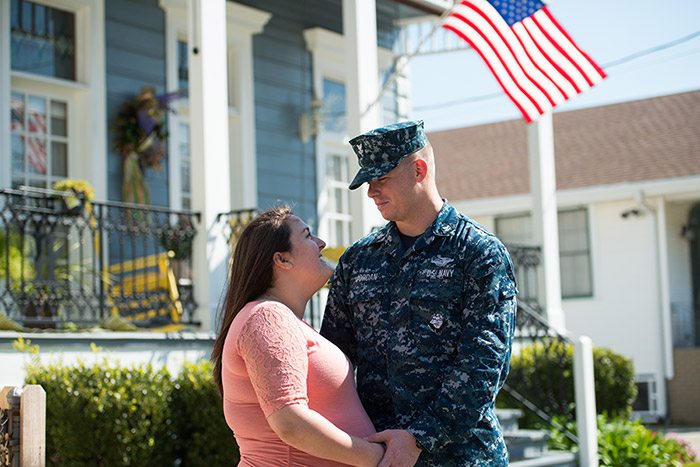
Texas Farm Bureau Insurance Agent Shannon Martin understands the special insurance challenges members face as they move from state to state with the military. She’s kept tabs on a couple from Kirbyville as they’ve started married life in the military — Texas Farm Bureau members Bryant and April Jordan.
When the Jordans tied the knot a year and a half ago, April knew she was also getting hitched to the U.S. Navy. “The biggest challenge was just trying to teach her all the military aspects [of life],” says Bryant, an E-5 Petty Officer 2nd Class who had served almost four years when they got married. “It was all new to her.”
But adjusting to military life is a challenge offset by the many benefits that come to military families. From local retail discounts to military benefits that can’t be matched in civilian life, learning to take advantage of them has its own learning curve.
Now expecting a baby, the Jordans enjoy the convenience of living on base in Belle Chasse, Louisiana, where they’re currently stationed. “It cuts down on our spending and saves money on gas,” says Bryant, who bikes or walks to work as an X-ray technician at the Naval Branch Health Clinic. The Navy is picking up the tab for April’s maternity appointments and the couple’s other medical needs. “They take care of everything,” Bryant says.
When Bryant had a permanent change of station from North Carolina to Louisiana, the Navy paid to move his household goods, and it’s paying his college tuition as he works toward his bachelor’s degree in health science.
But these same advantages and benefits of military service can actually make some service members less prepared for day-to-day living once they separate or retire from the military.
While you’re in the military, on-post help includes financial counselors, relocation assistance, and more, explains Bexar County Veterans Service Officer Queta Marquez. “It’s different once you leave the gate,” she says. “There’s such a disconnect. [For instance, veterans] don’t factor in that health care is paid for — that you and your family are 100 percent taken care of when you’re on active duty.”
That’s when people like David Sherman, a no-cost financial coach for post-9/11 veterans, can help financially stressed veterans get on the right track. Sherman works at the Good Samaritan Veterans Outreach and Transition Center at St. Philip’s College in San Antonio helping veterans solve problems with debt or poor credit scores. They develop action plans for improving finances — including asset protection with the right amount of insurance. A 360 Review® with your Texas Farm Bureau Insurance Agent can help determine your insurance needs, too.
To avoid a financial crisis as veterans, Sherman urges active-duty members to take advantage of financial literacy programs on bases and posts. “If you want to be successful in your personal finances just like you want to be successful as a military person, use all the tools available,” he says.
Sherman warns active-duty military about identity theft, as well. His son, a U.S. airman, discovered someone had led federal income taxes under his name hoping to steal his refund, which caused a real hassle. He suggests you try simple ways to prevent the problem: Shred key documents, use identity theft prevention software, and password-protect mobile devices.
Finding out about experts like Sherman is the hard part, as veterans navigate an overwhelming maze of groups and service providers all willing to help. Barbara Lau, a board member of San Antonio’s new Military and Veteran Community Collaborative, notes that 43,000 nonprofit groups nationwide help veterans, according to the IRS. Vetting each would challenge anyone, she says, especially veterans dealing with the transition or an injury. “Chances are they’re not going to get the help they need,” she says.
That’s why she’s part of an effort led by the San Antonio Area Foundation to create the Collaborative — a support group for the many local groups that serve the city’s military community. The goal? To get agencies talking to each other, so each knows what the other is doing. This way they can better direct veterans with greater efficiency. The strategy is gaining traction across the country.
Even long-established groups like the USO see the trouble with so many services and options. Chuck Bunch of San Antonio’s USO compares the problem to standing outside a Wal-Mart. “[Everything you need is there, but] you need to connect with someone who can turn on the lights and open the door,” says Bunch. USO programs Transition 360 and RP/6 (formerly RallyPoint/6), help to do just that, providing a central hub for veterans in need.
With the military and support groups starting to work smarter to provide better support, by the time the Jordans separate from the military, perhaps they’ll find an easier landscape to navigate. In the meantime, they’re doing their part with smart use of their military benefits and long-term planning. They don’t want to be part of the long line of veterans having trouble accessing benefits.
Attorney Jill Mitchell-Thein, director of the veterans’ benefits department at a San Antonio law firm and former board member for the National Organization of Veterans’ Advocates, has seen veterans miss out on what they deserve. She recommends that active-duty members get a thorough physical and/or mental exam before discharging to document any possible service-connected condition.
“I have seen so many veterans who may have been injured in the service, but toughed it out and never complained until many years later. Those claims rarely succeed,” Mitchell-Thein says, adding that the U.S. Department of Veterans A airs must see medical-record proof that the symptoms connect to military service.
For any service-related illnesses or injuries, file claims for disability compensation at discharge or as soon as possible afterward. “The sooner a claim is led, the sooner the clock starts running for their award or back benefits,” she says.
Heeding all this advice can help military families like the Jordans. With the baby on the way, April and Bryant are saving, staying well-insured, and spending wisely. “When we first married, we had had to live within our means, and still do,” Bryant says.
With that kind of self-disciplined attitude, they’ll likely handle the pressures of military life well now and later. And they’ll know they’re not in it alone.

Popping Open an American Tradition: A Journey Through the History of Tailgating
Tailgating’s surprising origins date back to the Civil War. Today, a less macabre tradition sustains school camaraderie and has become as central to an American pastime as goalposts and cheerleaders.

Field Day: Water Games for Kids
Ready, set, splash!
(Some of) The Best Food Trucks in Texas
You could say the chuck wagon is the original food truck. And food on wheels is bigger than ever in Texas.

A Few of Our Family’s Thanksgiving Traditions
Every family has their traditions. Here are some of ours.

Stop by These Roadside Fruit Stands and Orchards in Texas
Hit the road to pick up some of the best summer fruits.

The Ultimate Guide to Halloween in Texas
No tricks. We promise.