
Crafting an Authentic Pair of Cowboy Boots
Tex Robin can’t remember a time when he didn’t know how to make boots. His father started bootmaking in the early 1940s, when Robin was just a baby. As a child, Robin was surrounded by the leather and lasts, tacks and toe boxes of his dad’s shop.
“I just had a natural talent for it,” says Robin, 78. He inherited that talent from his father, W.L. Robin (also known as Tex), who, as far as Robin can tell, was a self-made bootmaker. “The only guys he worked for when I was younger were shoe cobblers, and they didn’t know how to make boots,” Robin says.
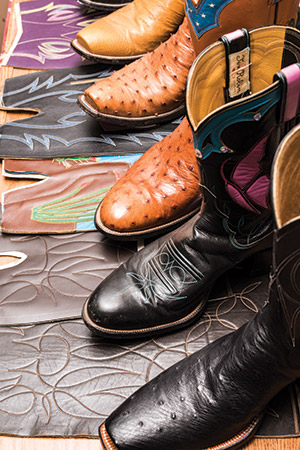
Bootmaking is an art unto itself, one that takes decades to fully grasp. Fortunately for the customers who value his individualized designs, Robin has more than 65 years’ experience crafting the intricate assembly of animal hide, pull straps, stitching, and soles to produce boots you’d never want to kick off.
A Timeless Product
When Robin’s father passed away in 1972, they were selling boots at $57.50 a pair and could make 15 pairs a week with the help of a few workers. Today, the boots go for $1,500 and up, and Robin crafts fewer than 30 pairs a year.
“It takes a lot of ingenuity and talent,” he says. “You’ve got to have an individual style of your own that people like.”
The price may have changed, but the method hasn’t. Even as the world has grown more automated, Robin has stuck to the classic ways. He has a few old machines, including one built before World War II that still runs perfectly with its original parts.
He’s not interested in new technology that can stitch a pair of tops with four panels in 10 minutes — for Robin, that takes about eight or nine hours, done row by row with excruciating attention to detail. It’s worth it for the results. “Ours look a lot better,” he says plainly.
It can take nine months from the time a customer orders to the time they can tap their heels in their new purchase. Patience is paramount.
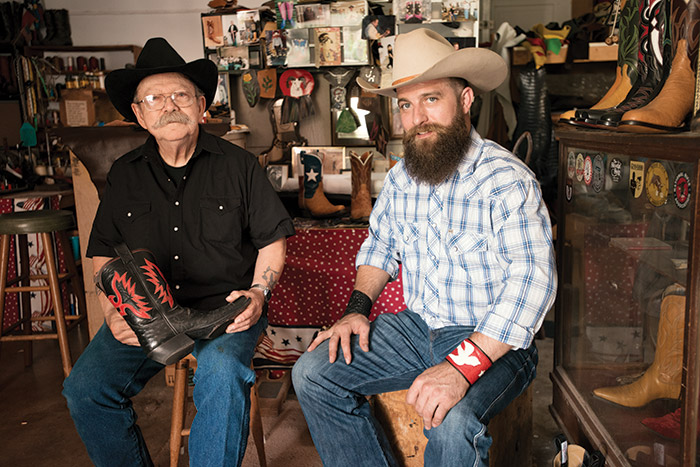
Robin’s style hasn’t changed much, either, although his artistry has evolved. His grandson, Justin Walker, 34, grew up around the shop, just as Robin did with his dad. He’s spent the last eight years as an apprentice.
He says his grandfather tends toward the “conservative cowboy style” of the 1950s and ’60s, using a lot of browns, oranges, and greens. Whereas others continually try to push the envelope, creating off-the-wall designs more befitting of high fashion than bootmaking, Robin stays true to what he knows and loves.
“He hasn’t allowed the customers to change what he thinks is the perfect boot,” Walker says. “He pretty much tells the customer what they’re going to get, and they like it every single time. That’s kind of what sets him apart from everyone else.”
The Next Generation
It’s probably no surprise that there are more bootmakers in Texas than in any other state — but even so, it’s not an easy trade to learn, even at its epicenter.
For one thing, it’s demanding. It requires both artistic talent and workmanship, which can be difficult to cultivate.
“Not everybody’s a Leonardo da Vinci,” Robin says. “If you’re not an artist, pretty soon people will look at your stuff and say, ‘That looks just like the boots in the stores.’ People don’t like boots that are in the stores; that’s not what they buy. They want a pair of boots that looks like a buckaroo was wearing it.”
Robin says it’s a challenging trade, and even those with the passion and drive face an uphill battle. “It’s really hard to just wake up one day and say, ‘I’m going to be a bootmaker,’” Walker says. There are hardly any schools for it, and finding a master bootmaker willing to teach is rare.
That’s where experienced artisans like Robin, who can pass on their hard-earned knowledge to the next generation, are important. Robin is mentoring Walker to someday take over the business. Two of his former protégés, Alan Bell and Brian Thomas, are now well-respected bootmakers in Abilene, too.
“There are a lot of young bootmakers out there, trying to make it and struggling,” Walker says. “Everyone needs to learn to make boots from someone like my grandfather.”
And if everyone could own a pair of boots from someone like his grandfather, that wouldn’t be so bad, either.
For more tales about inspiring Texans, read our story about a farming family in Central Texas who runs Horizon Dairy.
© 2017 Texas Farm Bureau Insurance