Please sign in as a member or guest below to access it.
Please sign in as a member or guest below to access it.

A simple chrysanthemum corsage bloomed into one of Texas’ most beloved — and recognizable — traditions.
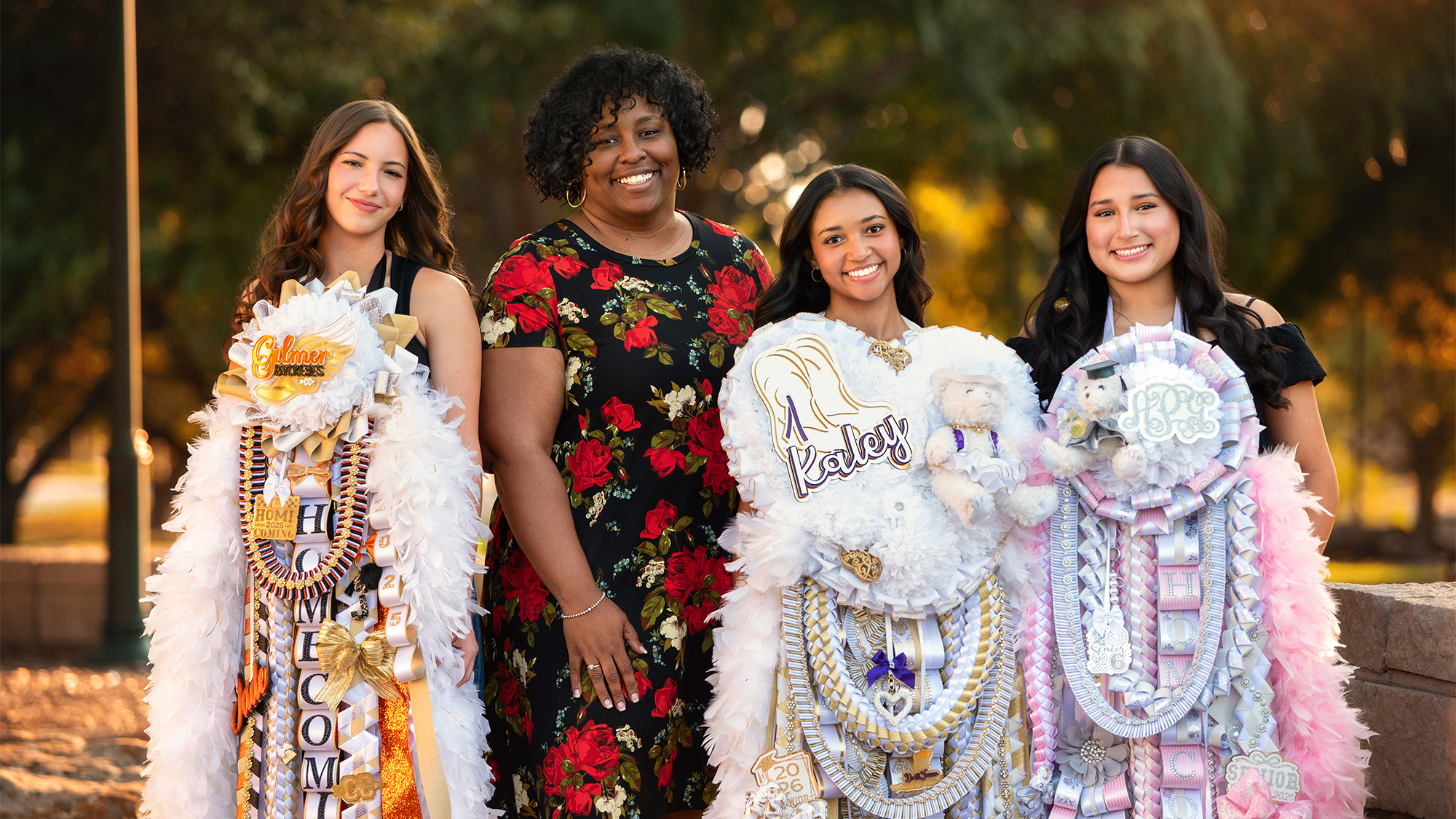
Every year, Texas homecoming mums grab statewide — and sometimes international — attention through endless news stories marveling at their magnitude and quirk.
That spectacle is exactly what drew in photographer, author, and communications professional Amy J. Schultz. Soon after moving to Texas in 2002, she was looking for fall décor in a Michaels craft store when she came across mum-making supplies — two aisles overflowing with colorful ribbon and intricate trinkets.
Sure, she’d gone to high school in Florida in the ’80s. But mums were nothing like this. At first, she thought they were odd Christmas decorations. “In Florida, nobody used artificial flowers for homecoming mums, and they weren’t highly embellished,” Schultz says. “It took me a minute to understand what I was seeing.”
Mums implanted in the back of her mind — the mark of a burgeoning Texan. Still fascinated years later, Schultz found herself making homecoming mums for a Fort Worth-area high school marching band’s fundraiser after an invitation from a good friend, who was running the benefit.
She was hypnotized by the precision, organization, and scale of the operation, which was completely run by women — mothers, grandmothers, aunts, friends of the students.
“I traveled back in time to places I’ve never been. I felt like this was what a quilting bee looked like, or even a barn raising,” Schultz says. “I had a sense that these people were creating something out of love. … It made me think of and miss my mom, who got involved in so many projects like this for my sisters and me when we were kids.”
This scene, juxtaposed with the annual “everything’s-bigger-in-Texas” media coverage, left her thinking: There’s no way that’s the right story.
“I wanted to understand the experience of a mum,” Schultz says. “And that experience took me in a lot of different directions.”
One direction was a yearslong project that culminated in the 2023 publication of “Mumentous,” a collection of original photos and stories from “deep in the heart of mum country.” (Her work has since morphed into a traveling cultural exhibit and was most recently displayed at the grand reopening of the UT San Antonio Institute of Texan Cultures.)
It’s believed that mums originated in Missouri in the 1910s, as American colleges and universities kick-started the now-beloved homecoming tradition. They were first spotted on a Texas homecoming queen in the 1930s at Baylor University. Since then, mums have evolved from simple, neatly pinned chrysanthemums to enormous, elaborate personalized works of art typically worn around the neck.
By the 1940s and 1950s, homecoming was commonplace at Texas high schools. The post-World War II baby boom and an influx of new Texans led to several schools being built across the state. “At this time, a homecoming mum was a live flower corsage,” Schultz says. “This put pressure on 24 FALL 2026 the supply chain, which at that time was completely controlled by florists.”
Ingenuity sparked in the early ’60s as florists battled supply versus demand. Mums were notoriously delicate, and everyone needed them on the same day. Time was a commodity, and florists wanted more of it, so some Texas florists started pushing customers toward longer-lasting artificial flowers.
At first, some customers balked at the “tackiness,” as artificial flowers weren’t considered stylish, Schultz says.
Clever florists offered a new suggestion: A more durable corsage would allow for an artificial flower to be added to the arrangement once the real flower faded.
An oil embargo in the early ’70s spurred a nationwide recession, driving many thrifty Texans to take a DIY approach to mum-making. In 1973, craft store Michaels was founded in North Texas, filling aisles with an assortment of ribbon, trinkets, and artificial flowers, much like the ones Shultz saw in the early 2000s. This abundance led to customization and mothers getting in on the mum-making process.
Suddenly, mums were a cherished personalized keepsake.
In typical Texan fashion, mums changed in Texas as they faded or remained modest elsewhere. “Texas had a secret sauce that nobody else did,” Schultz says.
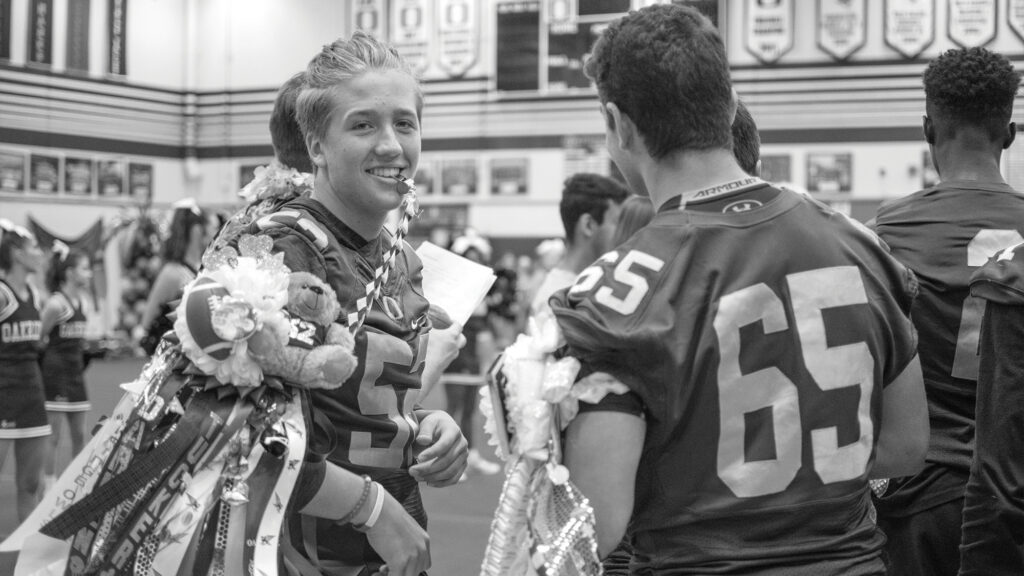
Now, mums are a cultural milestone. They adorn childhood bedrooms, hanging on bulletin boards, bedpost knobs, and doors decades after their moment in the Friday night limelight.
“[Mums are] kind of like a little memory for them, like a keepsake they can look back on,” says Rayanne Good, who co-owns North Texas’ RG Mums with Sabrina Rosser.
It’s a tradition that runs deep within communities and families. Even if parents don’t totally understand today’s headline-grabbing mums, it’s joyous to see their kids “opt in” to the experience of being part of something communal and encompassing — especially in high school, Schultz says.
“We live in a society now that does value team spirit. But we really value individual expression,” Schultz says. “In Texas, every generation has shaped what a homecoming mum looks like and what a mum means to the person who gives and receives it. Because mums continue to evolve in this way, they have remained relevant. A tradition that doesn’t allow for the next generation to make it their own will fade away.”
It’s a tradition that only grew stronger after the COVID-19 pandemic.
“I think people really realized, ‘This is an important memory. … We don’t want to miss that tradition,’” Rosser says.
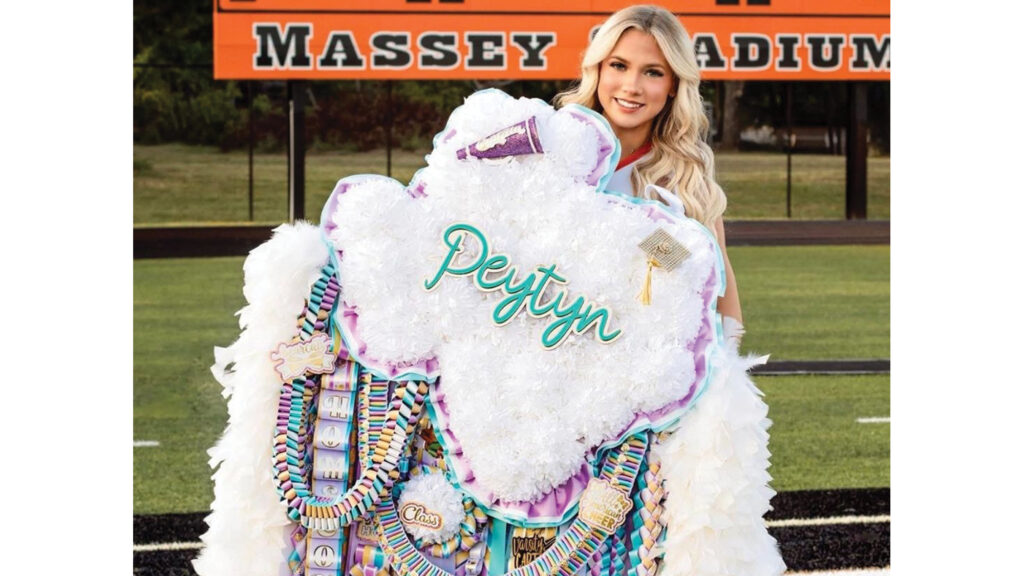
Mum-making has evolved into a multimillion-dollar industry in Texas — one largely helmed by women. While there are a few “token men,” Rosser says mum-making “creates an avenue for women to do what they love.”
Many mum-makers step into the industry through their children, while others come to the craft out of a love of creating. Kisha Clark, owner of the in-demand DK Florals Inc., started her business in 2002 at age 23, inspired by her adolescent love of making mums with her grandmother.
By day, Clark is a cybersecurity expert; she’s excelled in the field of information technology for nearly 30 years. Accustomed to bringing professionals together, Clark noticed a lack of community among her fellow mum-makers. Creators were siloed, and techniques were guarded. A decade into her business, she created Mums Inc., a professional organization for mum-makers built on setting a new standard for makers, while sharing information across the industry.
For Clark, mum-making is more than a hobby. It’s a serious business that’s helped mum-makers put their kids through college and even replace primary income.
“I’ve had investment bankers leave deal desks to become full-time mum-makers,” Clark says. “It’s just like any other business, other than its niche and different in how it’s run. But as far as what people rely on it for, it’s just like anything else.”
Successful creators are artists, marketers, operations managers, financial planners, and brand strategists — entrepreneurs through and through. Hundreds of mum-makers have benefitted from the expertise and community built through Mums Inc., which offers its members business education, design classes, and discounts and group buys.
Rosser and Good have grown RG Mums through their Mums Inc. membership.
“It was kind of what catapulted our [business],” says Rosser, who serves on the Mums Inc. board. “We learned some things that increased the quality of our mums. … It’s a great resource.”
Although they’re going into their sixth homecoming season, they’ve been friends for nearly 20 years, bonding in their shared navigation of raising teenagers.
Rosser and Good’s complementary strengths have built a successful, in-demand company. Rosser has a degree in organizational management and has owned several small businesses, while Good has been a teacher for 30 years, most of which she’s worked with fourth graders.
Careful logistics have also contributed to their success. Crafting mums, whether taking a DIY approach or calling in the professionals, is often a collaborative process between mothers and daughters. For mum-makers like RG Mums, there’s a consultation process that often starts long before homecoming. Typically, mum season is packed into about 10 weeks, but preparation happens year-round: Creators restock their inventory and schedule consultations, often for the coveted senior mums, months in advance.
The enduring characteristics of Mums Inc. — and the mum-making industry — are the community and camaraderie. With more than 5.5 million students stretching across more than 9,100 public schools in Texas, there’s no shortage of potential customers.
“You’re not really in competition because everybody’s going to find their niche,” Good says. “They’re not competition; it’s support.”
Take a deeper dive into the origins of Texas homecoming mums.
How Texas’ Cloud Seeding Program Helps Farmers
It might sound like sci-fi, but it’s really just science.
Hueco Tanks State Park: Texas’ Newest National Monument
Texas’ newest national monument is also one of its oldest historic sites. Explore the cultural gem that is Hueco Tanks.

Animals are in need across Texas.
Discover Holiday Magic in Grapevine
A guide to the “Christmas Capital of Texas.”

9 Wildlife Sanctuaries in Texas Where Wildlife Roams Free
Explore thousands of acres of Texas that have been set aside as national wildlife sanctuaries.
The Story Behind the $300K Hereford Steer
Two brothers from Meadow share how they led their steer to a record-breaking title.